
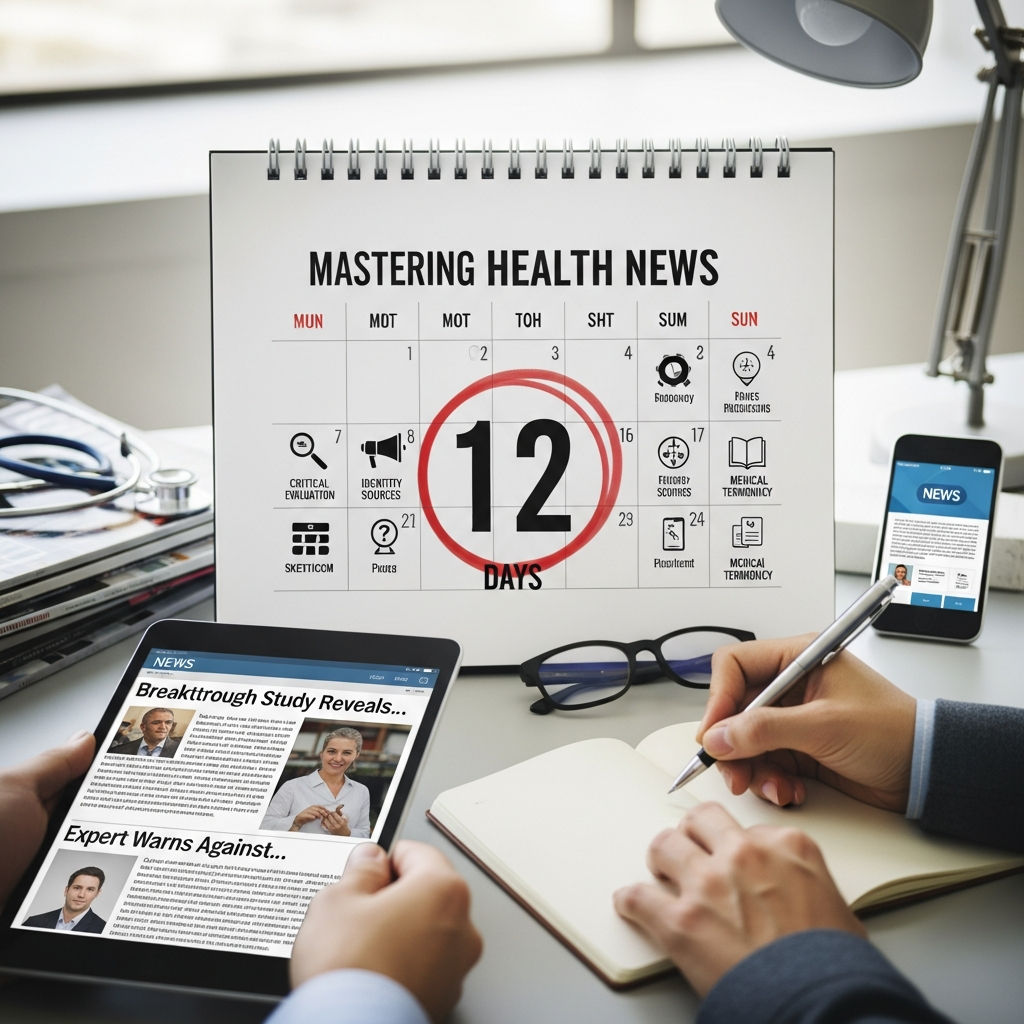
How to Master Health News in 12 Days: A Step-by-Step Guide to Health Literacy
In an era of information overload, staying informed about your health has never been more important—or more difficult. Every day, we are bombarded with headlines claiming that a new superfood will cure cancer or that a common habit is secretly killing us. This “infodemic” makes it nearly impossible for the average person to distinguish between breakthrough science and sensationalist clickbait.
Mastering health news isn’t about becoming a doctor or a scientist; it’s about developing health literacy. It’s the ability to find, understand, and use health information to make informed decisions. If you feel overwhelmed by conflicting reports, this 12-day intensive guide will transform you from a passive consumer into a savvy health news expert.
Day 1: Audit Your Current Information Diet
Before you can improve your intake, you must understand what you are currently consuming. Spend Day 1 tracking where your health news comes from. Do you get it from TikTok influencers, Facebook groups, morning talk shows, or reputable news outlets?
- Identify your top three sources of health information.
- Check if these sources cite original research or just “experts say.”
- Unfollow or mute accounts known for hyperbole or selling “miracle” supplements.
Day 2: Build a Roster of Trusted Authorities
Not all sources are created equal. On Day 2, clear out the noise and bookmark the “Gold Standards” of health information. Reliable health news usually originates from government agencies, academic institutions, and peer-reviewed journals.
- Government Agencies: The CDC (Centers for Disease Control), the NIH (National Institutes of Health), and the FDA.
- Academic Centers: Harvard Health, Mayo Clinic, and Johns Hopkins Medicine.
- Global Health: The World Health Organization (WHO).
Day 3: Understand the Hierarchy of Evidence
To master health news, you must understand that not all studies carry the same weight. On Day 3, learn the “Evidence Pyramid.” A single anecdote or a study done on mice is not the same as a massive human trial.
- Meta-analysis & Systematic Reviews: The strongest evidence, looking at many studies at once.
- Randomized Controlled Trials (RCTs): The gold standard for testing if a treatment works.
- Observational Studies: Good for finding links, but cannot prove cause and effect.
- Animal/Cell Research: Interesting “first steps” that often don’t translate to humans.
Day 4: Master the Art of Reading Headlines
Headlines are designed to grab attention, not to provide nuance. On Day 4, practice “Headline Skepticism.” If a headline sounds too good to be true, it probably is. Look for “red flag” words like “Miracle,” “Cure,” “Breakthrough,” and “Instant.” Mastering health news means realizing the headline is often the least accurate part of the story.
Day 5: Deciphering Absolute vs. Relative Risk
This is where most health reporting misleads the public. If a news story says a food “doubles your risk” of a disease, that is relative risk. On Day 5, look for the absolute risk. If the original risk was 1 in 1,000,000 and it doubles, your new risk is 2 in 1,000,000. It’s still incredibly low, but “100% Increase in Risk” makes for a much scarier headline.
Day 6: Correlation vs. Causation
On Day 6, focus on one of the most common errors in health journalism: confusing correlation with causation. Just because two things happen at the same time doesn’t mean one caused the other. For example, people who carry umbrellas are more likely to get wet—but carrying the umbrella didn’t cause the rain. Always ask: “Did this thing actually cause the outcome, or are they just happening together?”
Day 7: Follow the Money (Conflict of Interest)
Who paid for the study? On Day 7, learn to look for disclosure statements. If a study claiming that sugar isn’t harmful was funded by a soda company, you should view the results with healthy skepticism. While funding doesn’t always mean the science is bad, it provides vital context for the findings.
Day 8: Evaluate Sample Size and Demographics
A study on 10 professional athletes might not apply to a 60-year-old grandmother. On Day 8, look at the “N” number—the sample size. Larger samples (thousands of people) are generally more reliable than smaller ones. Also, check if the participants represent you in terms of age, gender, and ethnicity.
Day 9: The Importance of Peer Review
On Day 9, learn about the peer-review process. Before a study is published in a major journal like The Lancet or The New England Journal of Medicine, it is reviewed by independent experts. Be wary of “pre-prints” or studies released via press release before they have been vetted by the scientific community.
Day 10: Spotting Logical Fallacies
Health misinformation often relies on logical fallacies. On Day 10, familiarize yourself with these two common traps:
- Appeal to Nature: The idea that because something is “natural,” it is automatically safe and effective. (Cyanide and arsenic are natural, too!)
- Anecdotal Evidence: “My cousin took this pill and lost 20 pounds.” One person’s story is not scientific proof.
Day 11: Set Up Your News Ecosystem
Now that you have the skills, you need a system. On Day 11, automate your high-quality news intake. Use RSS feeds or Google Alerts for specific health topics you care about, but limit your sources to the “Gold Standards” you identified on Day 2. Subscribe to newsletters from reputable science communicators who “debunk” popular myths.
Day 12: Practice Synthesized Decision Making
On your final day, put it all together. Take a current trending health story and put it through your 12-day filter. Read the original study, check the sample size, look for the absolute risk, and identify any conflicts of interest. Mastering health news is a muscle; the more you use it, the stronger it gets.
Conclusion: The Lifelong Benefit of Health Literacy
By completing this 12-day journey, you have moved beyond the surface level of health reporting. You now possess the tools to protect yourself from scams, reduce unnecessary anxiety caused by “scare-headlines,” and make choices based on solid evidence rather than viral trends.
Health news will continue to evolve, and new “miracles” will be pitched every week. However, with your new critical thinking framework, you can navigate the noise with confidence. Remember: in the world of health, curiosity is good, but skepticism is your best defense.